
XPS: Production System
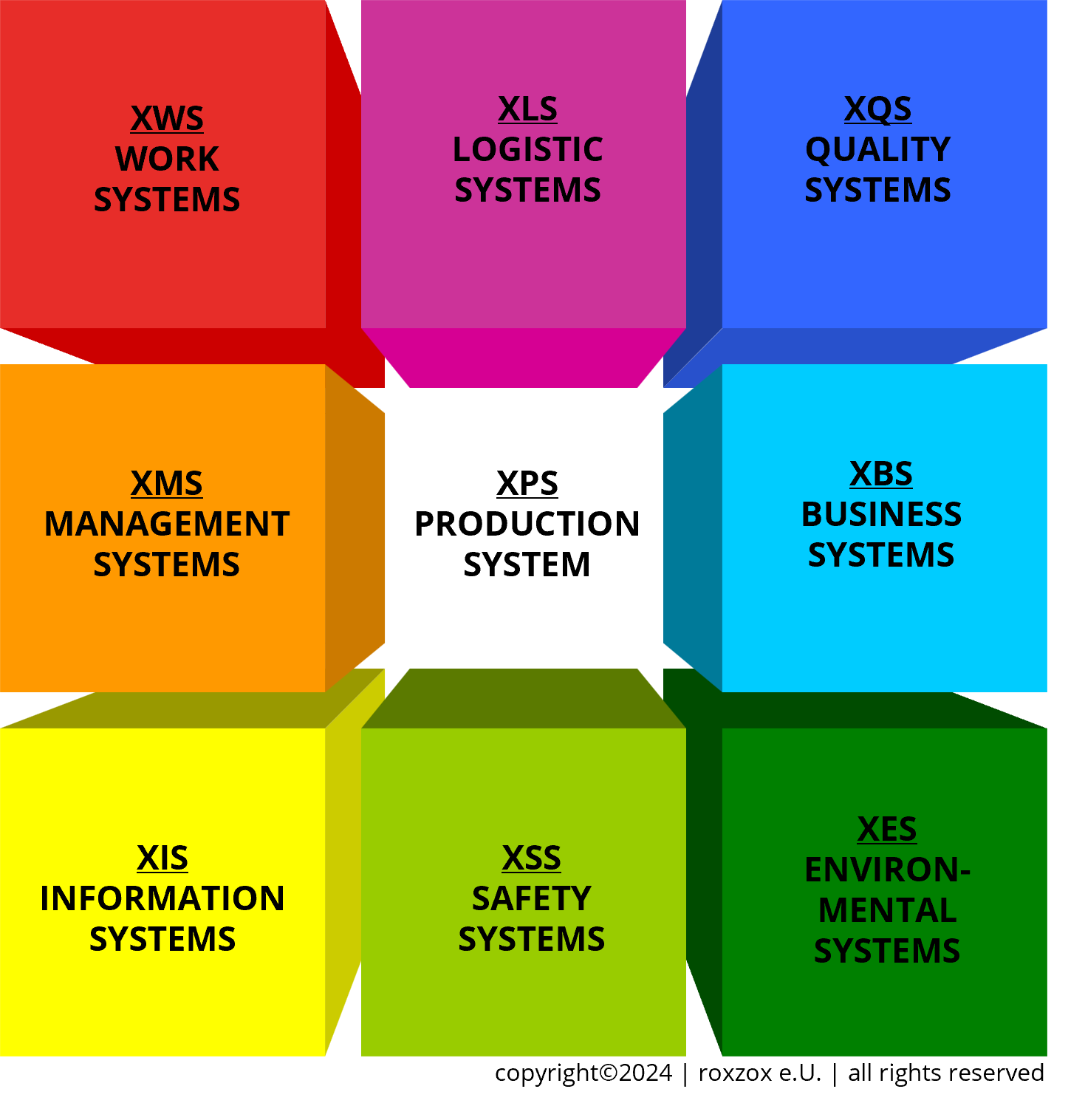
- The production system comprises all necessary system elements to run a successful operation. This means not only to meet production quotas, quality and cost targets. It means to make sure that the entire workplace for employees is safe, ergonomic, healthy and secure.
- People stay motivated and interested to continuously improve and strive for operational excellence. It also ensures to pursue long term goals such as legal and environmental compliance, data security and data integrity. By means of a smart data concept, the management system is fed with relevant data – for tracking, improving and controlling the operation.
- The elements of the XPS production systems are the work, management, information, safety, environmental, business, quality and logistic systems.
%
WORK SYSTEMS: Organize the work system (man, material and machine) so that ergonomics, satety, performance and quality It is ensured. Make sure that everthing and everyone is focused on supporting the worker doing the job.
%
MANAGEMENT SYSTEMS: Provide all data, information, tools and methods so that management gets the right feedback via KPI's to control and pursue a long term stratetgy.
%
INFORMATION SYSTEMS: Implement all business systems to bring information exactly to the point, where it is needed - just at the right time. Provide feedback of the actual state to enable forecasting of events.
%
SAFETY SYSTEMS: Make sure that everybody feels responsible for safety. 'Safety first' must be a fundamental principle in production: Every incident is reviewed thoroughly. Needed actions are taken immediately. Everybody is responsible for safety.
%
ENVIRONMENTAL SYSTEMS: Make sure that all resources (material, packaging, energy, scrap, waste, recycling) are handled ecologically correct. Visualize environmental improvements.
%
BUSINESS SYSTEMS: Provide all business systems, that are needed to operate production. Ahieve a true Industry 4.0 status. Integrate business systems seamlessly and remove legacy systems.
%
QUALITY SYSTEMS: Implement systems, tools and methods for systemic problem solving, continuous improvement, quality assurance and daily lessons learned.
%